.png)
Coir vs Peat in Greenhouses South Africa Choosing the Best Growing Medium for Sustainable Agriculture
- Sanvir Maharaj
- Mar 10
- 3 min read

Greenhouse growers in South Africa face a critical choice when selecting a growing medium. The decision between coir and peat affects crop health, water use, nutrient management, and environmental impact. Both materials have unique properties that influence plant growth and sustainability. Understanding these differences helps growers optimize production while supporting South Africa’s move toward sustainable farming.
This article explores what coir and peat are, their roles in greenhouse production, and how to choose the best medium for your crops and system. Whether you are a commercial grower or a developing farmer, this guide offers practical insights to improve your greenhouse outcomes.
What Are Coir and Peat and How Are They Used in Greenhouse Production?
Coir is a natural fiber extracted from the outer husk of coconut shells. It is processed into loose fibers, pith, or compressed blocks for use as a growing medium. Coir is widely used in greenhouses for seed starting, potting mixes, and hydroponic systems. Its fibrous structure provides good aeration and water retention.
Peat comes from partially decomposed sphagnum moss found in peat bogs. It has been a traditional growing medium for decades due to its high water-holding capacity and ability to retain nutrients. Peat is often used in potting soils and greenhouse beds to improve moisture retention and soil structure.
Both coir and peat serve as soilless substrates that support root development and nutrient uptake in controlled environments. They provide a sterile, consistent base for growing vegetables, flowers, and herbs in greenhouses.
Key Differences in Water Retention, Aeration, pH Levels, and Nutrient Management
Water Retention and Aeration
Coir holds water well but drains excess moisture efficiently, preventing waterlogging. Its fibrous texture creates air pockets that improve root oxygenation.
Peat retains more water than coir, which can be beneficial in dry conditions but may cause poor drainage and root suffocation if overwatered.
pH Levels
Coir typically has a near-neutral to slightly alkaline pH (5.5 to 6.8), which suits many crops but may require pH adjustment for acid-loving plants.
Peat is naturally acidic, with a pH around 3.5 to 4.5. This acidity benefits acidophilic crops like blueberries but often requires liming for neutral or alkaline-preferring plants.
Nutrient Management
Coir contains minimal nutrients and has a low cation exchange capacity, so growers must supply balanced fertilizers regularly.
Peat holds nutrients better due to its organic matter content but can tie up some nutrients, requiring careful fertilization.
Sustainability Considerations and Environmental Impact
Sustainability is a growing concern in South African agriculture. The choice between coir and peat has significant environmental implications.
Coir is a renewable byproduct of coconut farming, primarily sourced from countries like India and Sri Lanka. Using coir supports waste reduction and reduces reliance on non-renewable resources. It decomposes slowly and can be reused or composted.
Peat extraction damages fragile peatlands, which are important carbon sinks and biodiversity hotspots. Peat bogs take thousands of years to form, making peat a non-renewable resource. Its harvesting contributes to greenhouse gas emissions and habitat loss.
For growers committed to sustainable practices, coir offers a more environmentally friendly option that aligns with South Africa’s goals to reduce carbon footprints in agriculture.
Cost Factors and Availability in South Africa
Cost and availability influence medium choice for many growers.
Coir is imported into South Africa, which can increase costs due to shipping and currency fluctuations. However, its durability and reusability can offset initial expenses.
Peat is less commonly available locally and often imported, making it expensive and less accessible, especially for small-scale farmers.
SYA Agri Distributors works with suppliers to ensure steady access to quality coir and peat products, helping growers balance cost and performance.
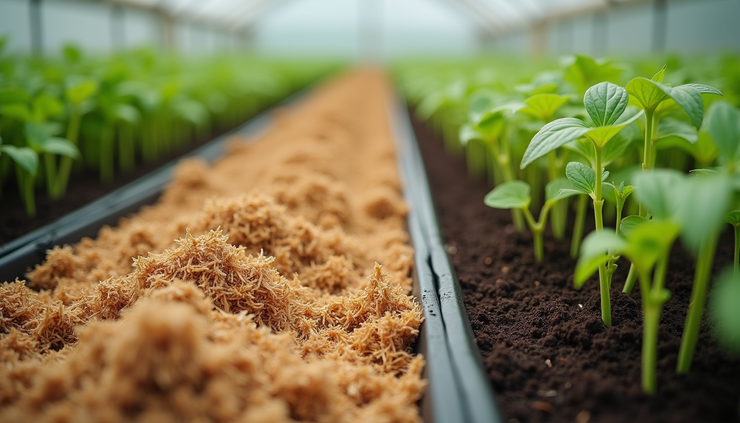
Coir vs Peat in Greenhouses South Africa: Which Crops Benefit Most?
Different crops respond better to specific growing media based on their water, pH, and nutrient needs.
Coir suits a wide range of vegetables such as tomatoes, peppers, cucumbers, and leafy greens. Its good aeration supports root health in fast-growing crops.
Peat favors acid-loving plants like blueberries and some ornamentals. Its moisture retention benefits crops sensitive to drought stress.
Growers should match the medium to the crop’s requirements and greenhouse conditions for optimal results.
How Growers Can Choose the Right Medium for Their Greenhouse System
Selecting the best growing medium depends on several factors:
Crop type and growth stage: Seedlings may need finer, well-drained coir mixes, while mature plants might benefit from peat’s moisture retention.
Water availability and irrigation system: Coir works well with drip irrigation due to its drainage, while peat suits flood or mist systems.
pH preferences: Adjust media or choose based on crop acidity needs.
Sustainability goals: Prioritize coir for lower environmental impact.
Budget and supply: Consider local availability and cost-effectiveness.
Testing small batches and monitoring plant response helps refine medium choice.
Comments